Let the work lead.
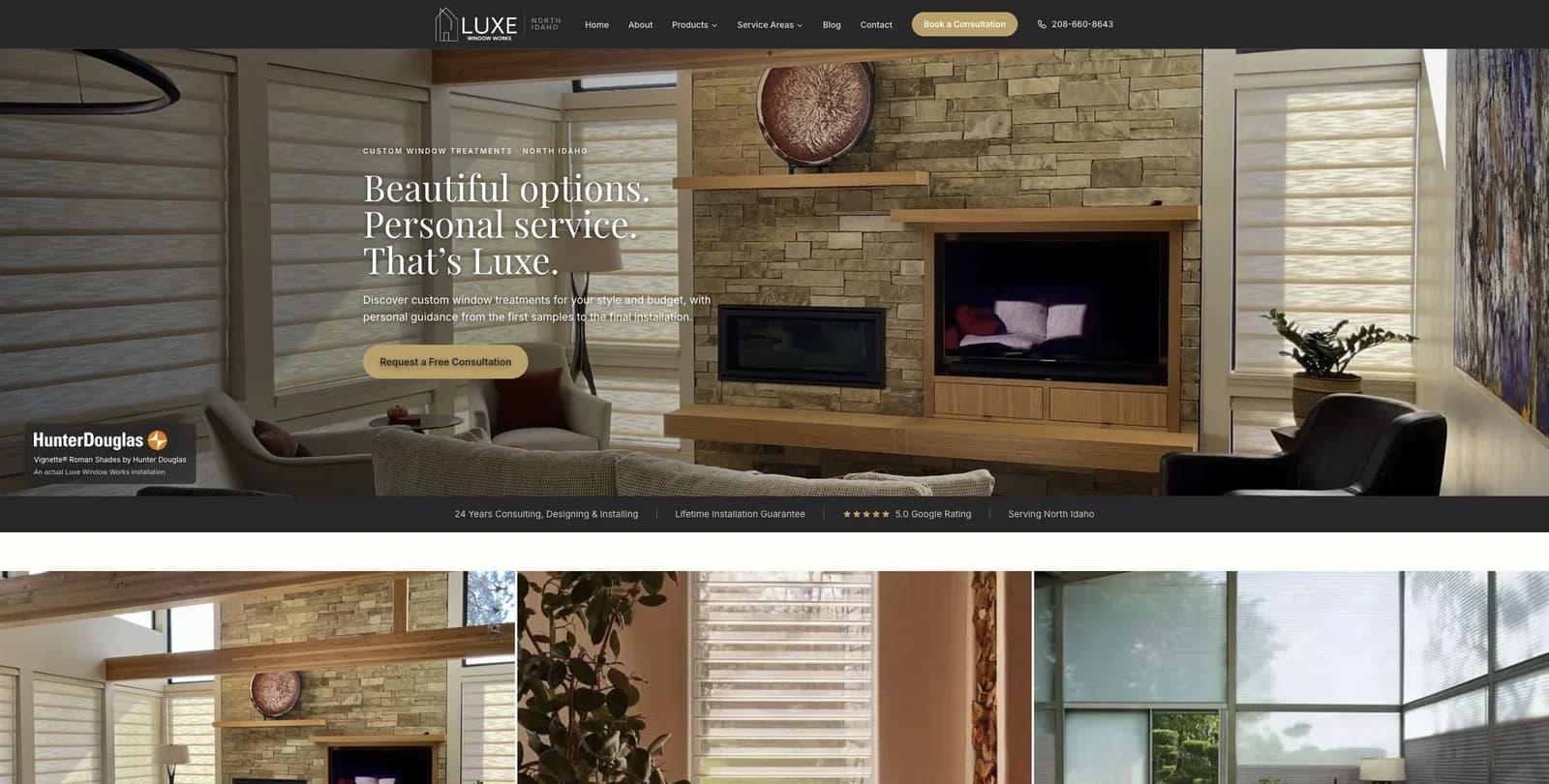
Real installation photography gives the products a setting. Rooms, materials, and natural light help visitors picture window treatments in a lived-in space.
Considered craftsmanship.
A considered digital experience.
Window treatments are a personal decision. Homeowners need to see the possibilities, understand the options, and know who will help them choose.
Luxe Window Works serves North Idaho with window-treatment products and in-home consultation requests. The website brings product collections, installation photography, and local service information into one customer journey.
Ownership disclosure: Mark Abplanalp owns both Luxe Window Works and Kodecite. This is a project for his own business, not an independent client endorsement.
Help a homeowner move from visual inspiration to a useful consultation request, with enough context to understand the products and whether Luxe serves their area.
The design and information need to work together: show the work, explain the options, and make the next step clear. A request begins a conversation; it does not confirm an appointment or a price.
Real installation photography gives the products a setting. Rooms, materials, and natural light help visitors picture window treatments in a lived-in space.
Product collections and service-area pages give visitors specific information to explore before contacting the business.
Consultation links connect the browsing experience to a request for human follow-up. The next step is visible without pretending that a visit is already booked.
Browse product collections and installation imagery.
Review service information and the areas Luxe serves.
Share the details needed for the business to follow up.
The team handles scheduling, advice, and confirmation.
Luxe also became a specific experiment in how an outside AI assistant could understand and submit an authorized consultation request. This custom experiment is separate from Kodecite’s standard website scope.
Mark’s historical account reports an accepted in-area request and an email arriving in the Luxe inbox. A repeated identical request returned the original outcome without a second email; a changed request under the same identity was rejected.
The original inbox artifact and full test transcript were not independently located for the article’s October 28, 2026 revision. These remain author-reported historical observations, not independently reproduced results or a promise of future performance.
A consultation request is not a booked appointment, quoted price, purchase, or accepted project. This case does not establish universal AI compatibility. Custom integrations and internal software management are outside Kodecite’s standard build.
Read the original technical accountSource: the existing Luxe article, updated October 28, 2026. Expand a topic for the underlying account and its limitations.
In the original account, I reported an authorized in-area test returning HTTP 200 with accepted / in_service_area, an email arriving in the Luxe inbox, a same-key replay returning the original outcome without a second email, and a changed payload with the same key returning HTTP 409 idempotency_conflict.
Those are author-reported historical observations. The original inbox artifact and full test transcript were not independently located for this revision. The public contract and implementation review support the intended behavior; they do not independently reproduce that historical inbox event. No production submission was made to update this article.
A receiving API can validate a request and call a delivery provider. A provider can accept that message for processing. The message can then be delivered, filtered, delayed or rejected downstream. A provider’s success response alone does not establish that a person saw the message in an inbox.
A strong test record distinguishes request acceptance, provider acceptance, delivery evidence and human follow-up. For this case, inbox arrival belongs to the historical author’s report. The request interface should describe its response at the level the system can actually establish.
The current public contract requires an idempotency key, describes same-key/same-request replay and rejects a changed request under that key. It declares a durable store available without publishing storage internals or thresholds. That is the published contract; a GET of it does not test every runtime failure.
Duplicate protection depends on the implemented key rules, persistence and retention scope. It does not prevent a user from creating another inquiry with a different key, and it is not an absolute promise that no duplicate can ever reach the business. Rate limits reduce repeated use; they do not authenticate an agent or prove that its customer consented.
No. The reported result was a consultation request for human follow-up. The public contract says direct booking is unavailable.
No. It remains Mark’s historical report. The original inbox artifact and full test transcript were not independently located for this revision.
No. It helps recognize a repeated request within the implementation’s scope. Customer authorization and agent identity require their own controls.
No. It describes the available interface. A test that creates a real request still needs authorization and appropriate handling by the receiving team.
The delivered work connects product storytelling, local business information, and a consultation path. That is what this case demonstrates. It does not claim a measured increase in leads, revenue, or bookings.
Explore what goes into a Kodecite build