Compressed Search Is Coming: Why Entity Trust Will Matter More Than Content Volume
Search interfaces are compressing from ten blue links to map packs to AI answers to a single spoken recommendation. When the list gets shorter, entity trust determines who gets recommended.
Mark Abplanalp
May 9, 2026
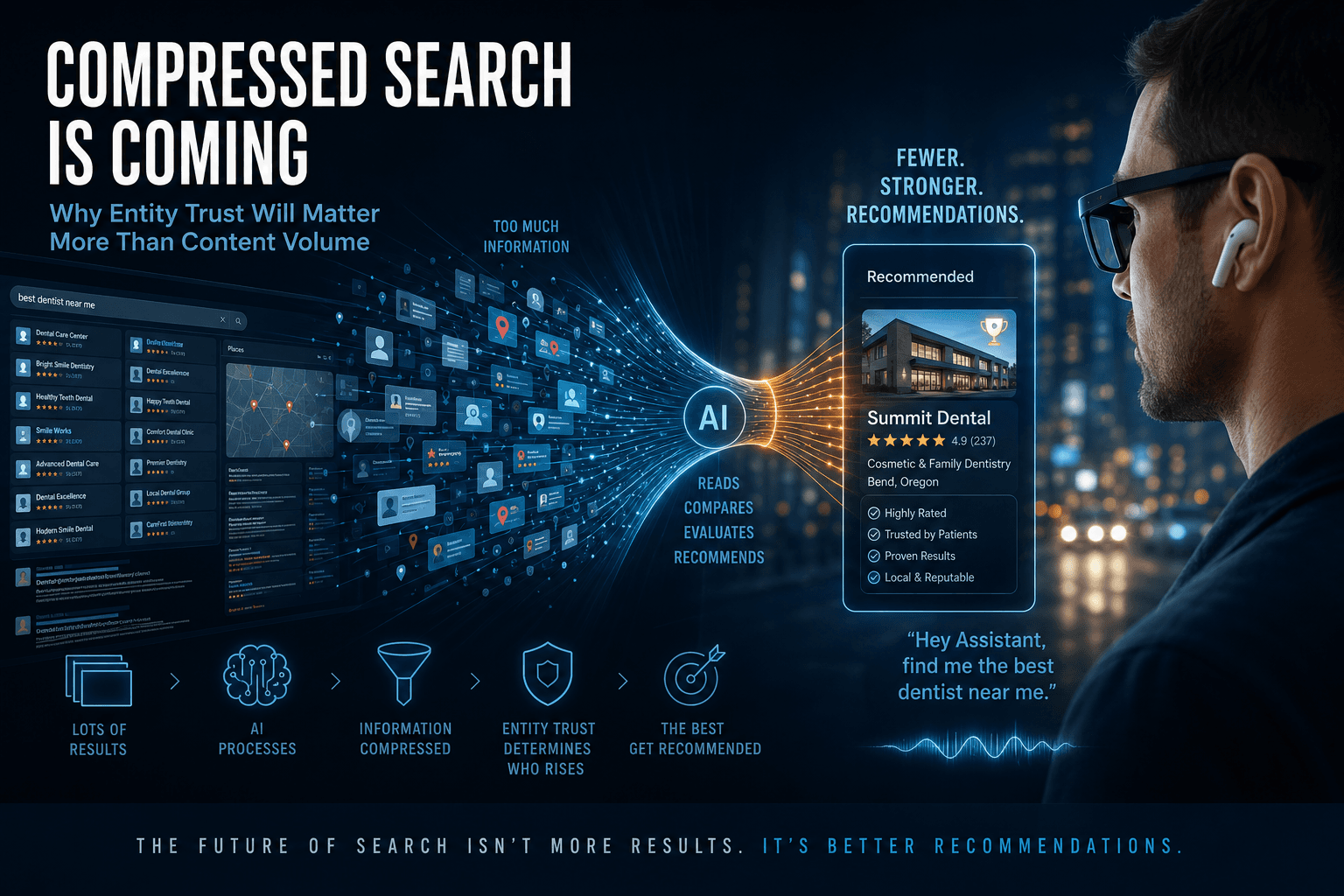
Search is changing for a simple reason: the interface is changing.
On a desktop, a search engine can show ten blue links, a map pack, ads, featured snippets, videos, images, and related searches.
On a phone, the screen gets smaller. The number of results people actually see shrinks.
But in a voice-first or wearable interface — earbuds, smart glasses, in-car assistants, AI agents, and screenless devices — the entire experience compresses even further. No one wants fourteen local business recommendations spoken into their ear. The interface forces a different behavior. Instead of showing everything, the system has to choose.
THE CENTRAL CLAIM
The future of local search is not more results. It is fewer recommendations. And when recommendations compress, entity trust becomes more important than content volume.
The Internet Is Not Dying. Human Browsing Is Being Abstracted Away.
The phrase “dead internet” gets used in a lot of different ways. Some versions are exaggerated. Some are conspiratorial. But one part of the idea is directionally correct: human browsing is becoming less central to discovery. Google itself has signaled this direction — at I/O 2026, it announced the biggest Search box redesign in 25 years, introduced agentic information agents, and rolled out agentic booking that completes tasks inside Search.
That does not mean websites disappear. It does not mean content disappears. It does not mean reviews, directories, videos, articles, or business profiles disappear. It means AI systems increasingly sit between the user and the web.
The user asks.
The agent searches.
The agent reads.
The agent compares.
The agent summarizes.
The agent recommends.
The web still exists underneath the interaction. The human may never manually browse it.
Websites Will Still Exist, But Their Job Is Changing
For the last twenty years, most business websites were built as digital brochures — designed to impress a human visitor after that visitor clicked. That still matters. But in AI-mediated search, the website has another job before the visitor ever arrives.
It has to help the machine understand the business. The site needs to answer machine-level questions clearly:
- ›Who is this business?
- ›What does it do?
- ›Where does it operate?
- ›Who provides the service?
- ›What proof supports its claims?
- ›Are those claims consistent across the web?
- ›Is the business real, relevant, and trustworthy enough to recommend?
A website that only looks good to humans but is confusing to machines is no longer enough.
AI Agents Will Read, Compare, and Recommend Before Humans Arrive
In traditional search, the business had a chance to persuade the visitor after the click. In agentic search, the AI may evaluate the business before the user ever sees the website. That changes the order of persuasion. The first audience is not always the human. The first audience may be the machine deciding whether the business belongs in the recommendation set.
That means the website has to be readable, structured, fast, consistent, and connected. It has to be built as a trust layer, not just a design asset.
The New Question Is Not “Can You Rank?” It Is “Can You Be Recommended?”
Ranking and recommendation are not the same thing. Ranking is placement in a list. Recommendation is selection. A business can rank somewhere on a page and still be ignored. But when an AI assistant gives only one, two, or three options, the stakes change. The question becomes: can the AI confidently recommend this business? That confidence does not come from one blog post, one backlink, one citation, or one directory listing. It comes from the full entity picture.
Search Is Moving From Results to Recommendations
Search is not moving in one clean jump. It is compressing in stages.
Desktop Search Gave Users Ten Blue Links
Desktop search had room. A user could scan results, open multiple tabs, compare businesses, read reviews, visit websites, and make a decision manually. That model rewarded visibility across a larger surface area. Being on page one mattered. Being in the map pack mattered. Having title tags, backlinks, reviews, and content mattered. Those signals still matter. But the interface allowed more options to exist.
Mobile Search Compressed Attention Into Maps, Snippets, and Ads
Mobile made search more compressed. Users still had a screen, but they were less likely to scroll deeply. Map packs, ads, snippets, and top organic results captured most of the attention. Local search became more competitive because fewer results were meaningfully visible. A business did not need to be number eleven. It needed to be one of the few options a mobile user actually saw.
AI Search Compresses the Journey Into Answers
AI search compresses the journey further. Instead of showing a user every possible source, the system synthesizes information and produces an answer. Google's AI Overviews — now serving over a billion users monthly across 100+ countries — and AI Mode both work this way, synthesizing across multiple sources and surfacing a small set of cited recommendations. The user is no longer doing the same kind of manual comparison. The AI system is helping decide which sources matter.
Wearables Will Compress It Even Further
Wearables create the most important shift. A screen can show options. A voice assistant has to speak them. Smart glasses, earbuds, watches, and in-car assistants create a natural limit on how many recommendations a user will tolerate.
THE COMPRESSION IN PRACTICE
“Here are twelve dentists in Bend, Oregon. Let me read each profile.”
“I found two strong options.” — or eventually: “I recommend this one.”
That is compressed search.
Why Screenless Search Changes the Game for Local Businesses
Local search has always been competitive. But screenless search changes the nature of competition. The user is not choosing from every business. The AI system is narrowing the field before the user engages. That means the business has fewer chances to explain itself after the search. It needs to be understood before the recommendation happens.
Voice Interfaces Force Smaller Recommendation Sets
Voice interfaces reward clarity. The clearer business wins because it is easier to summarize, easier to compare, and easier to recommend. A vague business creates hesitation. A clear business creates confidence.
If one dentist has a fast, structured website with clear provider schema, service pages, credentials, reviews, FAQs, and consistent external profiles — while another has a generic WordPress site with thin schema and disconnected reviews — the first business gives the AI system more to work with. That does not guarantee a recommendation. But it improves the odds significantly.
When the List Gets Shorter, Trust Signals Matter More
In a long list, weak signals can still appear somewhere. In a short list, weak signals get filtered out. Compressed search raises the bar. The AI system has to decide which businesses are safe, relevant, and credible enough to present. That makes small trust advantages more important:
None of these alone is the whole answer. Together, they compound.
Being Easier to Verify Becomes a Competitive Advantage
In compressed search, the best business does not always win. The clearest verifiable business has the advantage. A local business may have decades of experience, hundreds of reviews, loyal customers, advanced services, and strong community trust. But if that authority is not expressed in a machine-readable way, AI systems may not fully understand it. The business has trust in the real world. But the machine cannot see enough of it. That is the gap KodeCite is built to close.
Entity Trust Becomes the Foundation of AI Discovery
Entity trust is the machine-readable clarity around a business. It is not just whether the business has content. It is whether machines can resolve the business as a real, credible, local entity — the same principle behind Google's Knowledge Graph, built around “things, not strings.”
Entity Trust Starts With Clear Business Identity
A business entity should be obvious in code — not guessed, not implied, not reduced to a logo, not hidden inside generic plugin markup. The machine should be able to understand:
- ›This is the business.
- ›This is the business type.
- ›This is the location.
- ›This is the phone number.
- ›This is the service area.
- ›These are the external profiles.
- ›These are the services.
- ›These are the people connected to the business.
For many established SMBs, this layer is either missing or badly underbuilt.
The Machine Needs to Understand the Person Behind the Business
For professional service businesses, the person often matters as much as the company. Dentists, doctors, attorneys, realtors, aestheticians, advisors, architects, specialty contractors. The provider's identity, credentials, experience, role, and expertise should connect to the business entity.
THE PERSON IS PART OF THE TRUST GRAPH
Schema Turns Real-World Authority Into Machine-Readable Structure
Schema.org — the shared vocabulary co-founded in June 2011 by Google, Microsoft, and Yahoo — does not create trust. Schema expresses trust. That distinction matters.
A weak business cannot become authoritative because it added structured data. But an established business with real authority can become much easier for machines to understand when that authority is structured correctly. Google's structured data documentation is explicit that markup must align with the real, visible content of the page — the goal is not to stuff code onto a page. The goal is to translate what is already true about the business into a clean machine-readable entity graph.
Content Still Matters, But Entity Governs Content
Content is not dead. Generic content is dying. Content still matters because AI systems need information to read, summarize, compare, and cite. But content works best when it strengthens a clearly defined entity.
Entity Tells the Machine Who Should Be Trusted
Content without entity clarity is weaker. A model may read a useful article, but still struggle to resolve who wrote it, what business published it, where that business operates, and whether the claims are supported. Entity gives content a home. The article is not floating in space.
It belongs to a business.
It is written by a person.
It supports a service.
It connects to a location.
It references proof.
It strengthens the entity.
Articles Should Strengthen the Business Entity
Every article should do more than target a keyword. It should strengthen the business's machine-readable identity. A realtor article about buying and selling at the same time should connect to the realtor entity, buyer service page, seller service page, relevant city pages, and client review proof. A dentist article about full mouth reconstruction should connect to the dentist entity, restorative dentistry page, cosmetic dentistry page, provider credentials, FAQs, videos, and relevant patient trust signals.
That is content governed by entity. Most business blogs are disconnected — published because someone said “content helps SEO,” but not reinforcing a larger structure. The question is not how much content you have. The better question is what your content makes clearer about your business.
Why Established SMBs Have the Biggest Opportunity
The biggest opportunity is not with businesses that have no authority. The biggest opportunity is with established businesses whose authority is real but poorly expressed online.
Most Strong Local Businesses Already Have the Trust
Many local businesses have already done the hard part. But at the machine level, many of these businesses look generic.
THE GAP BETWEEN REAL AUTHORITY AND MACHINE AUTHORITY
A 28-year dental practice
may be reduced to a basic organization with a logo.
A top realtor
may have proof scattered across Zillow, Google, and brokerage profiles but no owned transaction graph.
A skilled contractor
may have hundreds of completed projects but no structured project archive.
An attorney
may have credentials, practice areas, and client trust, but no clean entity relationship in schema.
The authority exists. It just is not machine-readable. That is not an authority problem. It is a translation problem.
KodeCite Translates Existing Reputation Into Machine-Readable Infrastructure
KodeCite is built for the business that already earned trust. The goal is not to manufacture authority. The goal is to structure it. We take the business's real-world assets — reviews, credentials, services, locations, providers, articles, videos, listings, projects, FAQs, and proof — and connect them into a machine-readable foundation that helps search engines and AI systems understand the business more clearly.
External Platforms Should Corroborate You, Not Own Your Proof
External platforms matter. Google matters. YouTube matters. Zillow matters. Yelp matters. BBB matters. But those platforms should not be the only places where a business's proof lives.
Realtor Proof Should Not Live Only on Zillow
A realtor's transaction history is one of the strongest forms of proof. But too often that proof lives on Zillow, Realtor.com, Homes.com, MLS feeds, or brokerage platforms — while the realtor's own website gets left with a bio, a contact form, and a few generic service pages.
Every listing should become an owned proof asset. When the property is active, it exists as a structured listing page. When it sells, it becomes a permanent sold-property page. When the client leaves a review, that review can become a transaction story linking back to the sold listing, the service page, and the realtor entity. That creates a transaction-based authority graph. The proof no longer disappears. It compounds.
YouTube Videos Should Strengthen the Website Entity
YouTube is useful, but YouTube's ecosystem is built around YouTube. A business video should not depend entirely on YouTube's algorithm. When a video is embedded on the business website and marked up with VideoObject schema — following Google's video structured data guidelines — it can strengthen the owned entity graph. The video becomes part of the website's trust infrastructure — not a post on someone else's platform.
The Website Should Become the Source of Truth
The right relationship:
The website defines the entity.
Google corroborates it.
YouTube supports it.
Zillow supports it.
Directories support it.
Reviews support it.
Everything should point back to one clear business identity.
The Businesses That Move Early Are Claiming Digital Real Estate
Local markets are still early. Most SMB websites are not built for agentic search. They were built for the old web: a human visitor, a visual design, a contact form, and maybe some basic SEO plugin settings. That leaves an opening.
Small Technical Advantages Compound Over Time
The advantage may not come from one dramatic change. It may come from dozens of small improvements working together:
Each improvement reduces uncertainty. Each improvement makes the business easier to resolve.
The Early Window Will Not Stay Open Forever
This window is real, but it will not stay open forever. Eventually, more agencies will learn the language of AEO, GEO, entity graphs, schema, and machine-readable trust. But local markets move slowly. Many agencies are still selling the old model. Many SMBs are still running on outdated platforms. Many established businesses still have major gaps between their real-world authority and their machine-readable authority. That gap is the opportunity.
What KodeCite Builds for the Agentic Web
KodeCite builds the foundation local businesses need as search moves from rankings to recommendations. The goal is not to chase every AI citation. The goal is to make the business easier for AI systems to understand, verify, and recommend.
Fast Infrastructure for Clean Machine Access
A modern site should be fast, crawlable, structured, and designed for extraction — clean rendering, clean sitemaps, strong performance against Core Web Vitals, stable URLs, and a technical foundation that does not fight the rest of the strategy.
Entity Graphs That Define the Business Clearly
The entity graph defines the business, the people, the services, the locations, the content, the reviews, the videos, and the external profiles. The goal is to reduce ambiguity. The machine should not have to guess who the business is or what it does.
Service and Location Pages Built for Extraction
Service pages should answer specific buyer questions. Location pages should clarify where the business operates. FAQs should reflect real customer concerns. Articles should support service authority. Content should be built to help both humans and machines understand the business.
Owned Proof Assets That Compound Over Time
The strongest businesses already create proof every day — they complete projects, serve patients, close transactions, earn reviews, publish videos. KodeCite turns those moments into owned digital assets. Not disposable posts. Not scattered platform signals. Owned proof that compounds.
The Future of Local Search Is Fewer Recommendations
The future of local search is not a longer results page. It is a shorter recommendation set. Citations matter. Mentions matter. Backlinks matter. But they are reinforcement signals — not the foundation. If the entity is unclear, those signals reinforce confusion. If the entity is clean, structured, and verifiable, those signals compound.
THE GOAL
Become the business AI can understand, verify, and recommend.
- ›Who they are.
- ›What they do.
- ›Where they operate.
- ›Who provides the service.
- ›What proof supports them.
- ›What content demonstrates expertise.
- ›What external sources corroborate them.
- ›What makes them safe to recommend.
In the old web, your website had to persuade a visitor. In the agentic web, your website has to inform the machine before the visitor ever arrives. That is why machine-readable trust infrastructure matters.
Because when AI only gives two recommendations, being easier to understand may be the difference between being invisible and becoming the answer.
Frequently Asked Questions
What is compressed search?
Compressed search describes the progressive narrowing of how many results a user sees as search interfaces evolve. Desktop showed ten blue links. Mobile compressed to map packs and snippets. AI synthesizes a direct answer. Wearables and voice compress further still — to one or two spoken options.
What is the difference between ranking and being recommended?
Ranking is placement in a list. Recommendation is selection. A business can rank on page one and still be passed over. In agentic search — where an AI assistant narrows to one or two options — the business either gets recommended or it doesn't.
Why does entity trust matter more as AI search grows?
When recommendation sets compress, AI systems need to choose among options. The business with a clearly defined, consistently verified entity graph is easier to understand and safer to recommend. Weak entity signals get filtered out when the list is short.
How can an established local business improve its machine-readable authority?
Most established businesses already have the hard-to-fake assets: reviews, credentials, completed work, years in business, local reputation. The gap is structural. Translating existing real-world authority into clean schema markup, consistent directory profiles, and connected service and provider pages is where the work starts.
What does it mean for a website to be machine-readable?
A machine-readable website is one that AI crawlers can access, parse, and understand without ambiguity. It requires server-side rendering, correct JSON-LD schema, consistent NAP data matching external profiles, internal linking that reinforces entity relationships, and content structured to answer specific questions.
THE WINDOW IS OPEN
Find out where you actually stand.
A Machine Read shows you exactly what AI systems can verify about your business right now, and where the gaps are.